
Updated Oct 26, 2026
What is Advent?
Advent is the season of waiting and preparation before Christmas. The word comes from the Latin adventus, meaning “coming” or “arrival.” In Western Christian churches — Catholic, Lutheran, Anglican, Methodist and many others — Advent begins on the fourth Sunday before Christmas and includes four Sundays. Because Christmas falls on a different weekday each year, the first Sunday of Advent moves too, landing somewhere between late November and early December.
For churches, Advent also marks the start of a new liturgical (church) year. Its themes are hope, peace, joy and love, and it looks forward both to celebrating Jesus’s birth and to his promised return. Eastern Orthodox churches observe a longer period of preparation, often called the Nativity Fast.
Outside church, “Advent” has come to mean the whole countdown to Christmas — especially the days of December marked by an Advent calendar. Families of every background enjoy the anticipation of opening one little door each day.
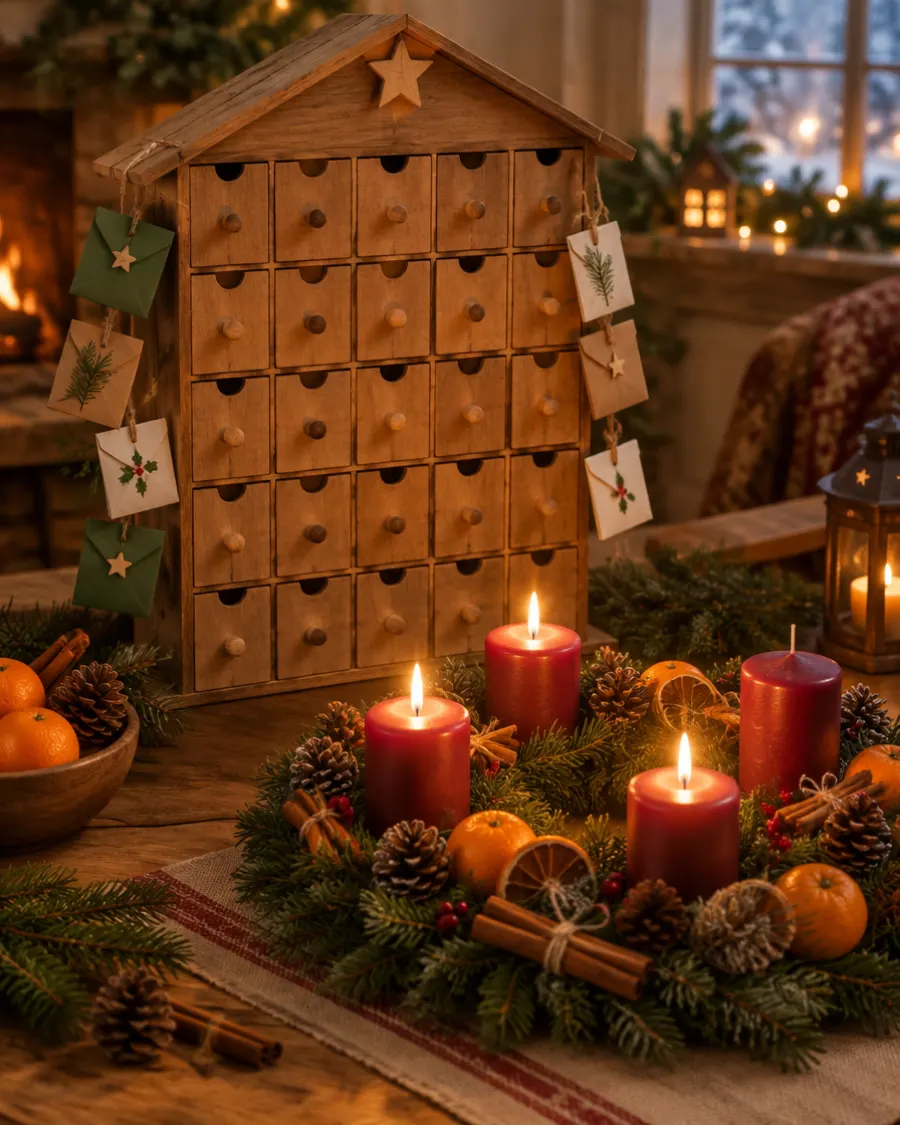
The Advent wreath and its candles
An Advent wreath is a circle of evergreen branches holding four candles, one lit for each Sunday of Advent. The circle is often explained as a symbol of eternity, and the evergreens as a sign of life that lasts through winter.
The modern wreath is usually traced to Johann Hinrich Wichern, a Lutheran pastor who ran a home for poor children in Hamburg, Germany. In 1839, tired of the children asking every day whether Christmas had come yet, he is said to have placed candles on an old wooden cartwheel — small candles for weekdays and large ones for Sundays — lighting one more each day. Over time the idea was simplified to four candles on an evergreen wreath. It spread through German churches and homes and became common in the United States in the 20th century.
- 1First Sunday — HopeOften a purple candle, sometimes called the Prophecy candle.
- 2Second Sunday — PeaceAnother purple candle; the first is lit again too, so two now burn.
- 3Third Sunday — JoyIn many traditions a rose or pink candle, for Gaudete (“rejoice”) Sunday.
- 4Fourth Sunday — LoveThe final purple candle. All four are lit.
Customs vary by church: some use blue candles instead of purple, some use all white or red, and the meaning of each candle can differ. Many families add a white Christ candle in the center, lit on Christmas Eve or Christmas Day.
Never leave a lit wreath unattended, keep it away from curtains and drying greenery, and use a sturdy, non-flammable base. Battery-operated candles are a safe choice for homes with young children or pets.
A short history of the Advent calendar
The Advent calendar grew out of German Protestant homes in the 19th century. Families found simple ways to count the days until Christmas: marking chalk lines on a door and rubbing one off each day, lighting a candle a day, or hanging a small religious picture each morning.
Printed Advent calendars came in the early 20th century. Many historians credit Gerhard Lang, a printer in Munich, with producing one of the first commercial printed Advent calendars around 1908. According to the story often told about him, his mother had made him a homemade calendar as a child, with small treats attached to cardboard, one for each day. Lang’s early calendars had pictures to cut out and paste onto a sheet; versions with little doors to open came later. Sources disagree on some exact dates, so treat specific “firsts” with a little caution.
Calendar printing in Germany was interrupted by paper shortages during World War II, but after the war production resumed and the calendars became hugely popular, reaching American homes in growing numbers in the decades after the war. Chocolate-filled calendars arrived later in the 20th century, and today you can find Advent calendars filled with everything from toys and puzzles to tea, socks and building bricks.
Advertisement
Advent traditions in American homes
- Advent calendars — paper, chocolate, toy-filled or handmade, opened each day starting December 1.
- Advent wreaths — lit at Sunday dinner, often with a short reading, prayer or song.
- Jesse trees — a small tree or branch decorated day by day with ornaments representing Bible stories leading to the Nativity.
- St. Nicholas Day (December 6) — in families with German, Dutch and other European roots, children leave shoes out the night before and find small treats in the morning. Learn more in our Santa Claus history.
- Book-a-day countdowns — wrapping 24 holiday picture books (many from the library or your own shelves) and unwrapping one each night at bedtime.
- Kindness calendars — one good deed for each day of December.
24 Advent activity ideas — one for each day
An activity calendar — a slip of paper with a simple plan behind each door — gives kids something to look forward to without adding a pile of stuff. Mix big and small, and save the bigger outings for weekends. Rearrange the list to fit your family’s schedule:
- 1Decorate the treePut on holiday music and hang ornaments together.
- 2Write letters to SantaTry our Santa letter maker.
- 3Make paper snowflakesTape them to the windows.
- 4Hot cocoa nightSet up a toppings bar with marshmallows and sprinkles.
- 5Color Christmas pagesPrint some coloring pages.
- 6St. Nicholas Day shoesLeave shoes out the night before for a small treat.
- 7Watch a Christmas specialPick from our movie guide.
- 8Donate toysChoose toys or clothes to give to a local drive.
- 9Make a bird feederPinecones, peanut butter (or sunflower butter) and seeds.
- 10Find your elf nameUse our elf name generator.
- 11Read a Christmas storyCuddle up with a classic picture book.
- 12Make homemade cardsFor grandparents, teachers or a nursing home.
- 13Drive to see lightsBring cocoa and pajamas. See our lights guide.
- 14Bake cookiesTry a recipe from our cookie guide.
- 15Christmas trivia nightPlay our trivia quiz.
- 16String popcorn garlandAdd cranberries for color (for older kids).
- 17Deliver treatsBring cookies to a neighbor, mail carrier or firefighters.
- 18Joke nightTake turns reading Christmas jokes at dinner.
- 19Build a gingerbread houseGraham crackers work fine as walls.
- 20Wrap gifts togetherKids can decorate plain paper with stamps.
- 21Celebrate the longest nightAround the winter solstice, have a candlelit dinner.
- 22Sing carolsPrint lyrics from our carols page.
- 23Make reindeer foodOats and sprinkles to scatter on the lawn (skip glitter — it harms wildlife).
- 24Christmas Eve boxNew pajamas, a book and cocoa. See our Christmas Eve guide.
How to make a DIY Advent calendar
A homemade Advent calendar can be reused for years and becomes a treasured decoration. Here are four easy styles, from five-minute to weekend project:
You need: 24 small envelopes, twine, mini clothespins, a marker or number stickers, and small notes or treats.
- Number the envelopes 1 to 24.
- Tuck an activity slip, a joke, a sticker or a flat treat inside each one.
- Stretch twine across a mantel, window or wall.
- Clip the envelopes in order — or mix them up so kids have to hunt for the day’s number.
You need: 24 small paper bags or boxes, paint or markers, a tray or shelf.
- Decorate each bag or box like a little house with windows and doors.
- Number each one and fill it with a small item.
- Fold the bag tops down and seal with a sticker.
- Arrange them as a village on a shelf or tray.
You need: 24 cardboard tubes, tissue or wrapping paper, glue, a large piece of cardboard.
- Cut tubes in half if you want a shorter calendar, then glue them side by side onto cardboard in a tree or grid shape.
- Fill each tube with a small treat or note.
- Cover the front opening with tissue paper, glued around the edges.
- Number each one — kids poke through the paper to open the day.
You need: 24 small felt or fabric stockings (sewn or store-bought), iron-on or felt numbers, a dowel or garland.
- Attach a number to each stocking with fabric glue or stitches.
- Loop a ribbon through the top of each one.
- Hang them from a dowel, a stair rail or along a garland.
- Refill each year with fresh surprises.
Filler ideas that are not candy: stickers, hair ties, temporary tattoos, small puzzles, dollar-store toys, coupons for “stay up 15 minutes late,” a new ornament or a riddle that leads to a hidden treat.
Making Advent part of your family tradition
The best Advent traditions are the ones you can actually keep up. A few tips from families who have done it for years:
- Keep weekdays small. A joke, a sticker or a two-minute activity is plenty on a busy school night.
- Prepare ahead. Fill the whole calendar on one evening in late November so you are not scrambling at bedtime.
- Take turns. With several kids, let them take turns opening doors, or give each child their own small calendar.
- Add meaning. If your family is religious, pair the calendar with a short reading or the Advent wreath on Sundays. If not, focus on kindness, giving and togetherness.
- Be flexible. Missed a day? Open two tomorrow. The point is anticipation and time together.
Watch the days tick down with our Christmas countdown, and find more ideas in our family activities guide.
Frequently asked questions
When does Advent start?
Advent begins on the fourth Sunday before Christmas, so the start date changes each year, falling between late November and early December. Many Advent calendars, however, simply start on December 1.
What do the four Advent candles mean?
They are commonly said to represent hope, peace, joy and love, one for each Sunday of Advent. Many churches use three purple candles and one rose or pink candle for the third Sunday; some use blue or white. A white Christ candle in the center is often lit on Christmas.
Who invented the Advent calendar?
Families in 19th-century Germany counted down to Christmas with chalk marks, candles and pictures. The Munich printer Gerhard Lang is often credited with one of the first commercial printed Advent calendars, around 1908.
Who invented the Advent wreath?
The modern Advent wreath is usually credited to Johann Hinrich Wichern, a Lutheran pastor in Hamburg, Germany, who in 1839 used candles on a wooden wheel to help children count the days to Christmas.
Advertisement