Updated Oct 26, 2026
Where the Christmas tree came from
People have brought evergreens indoors in winter for a very long time. Green branches that stayed alive through the coldest months were natural symbols of life and hope, and many cultures used them to decorate homes and temples around midwinter.
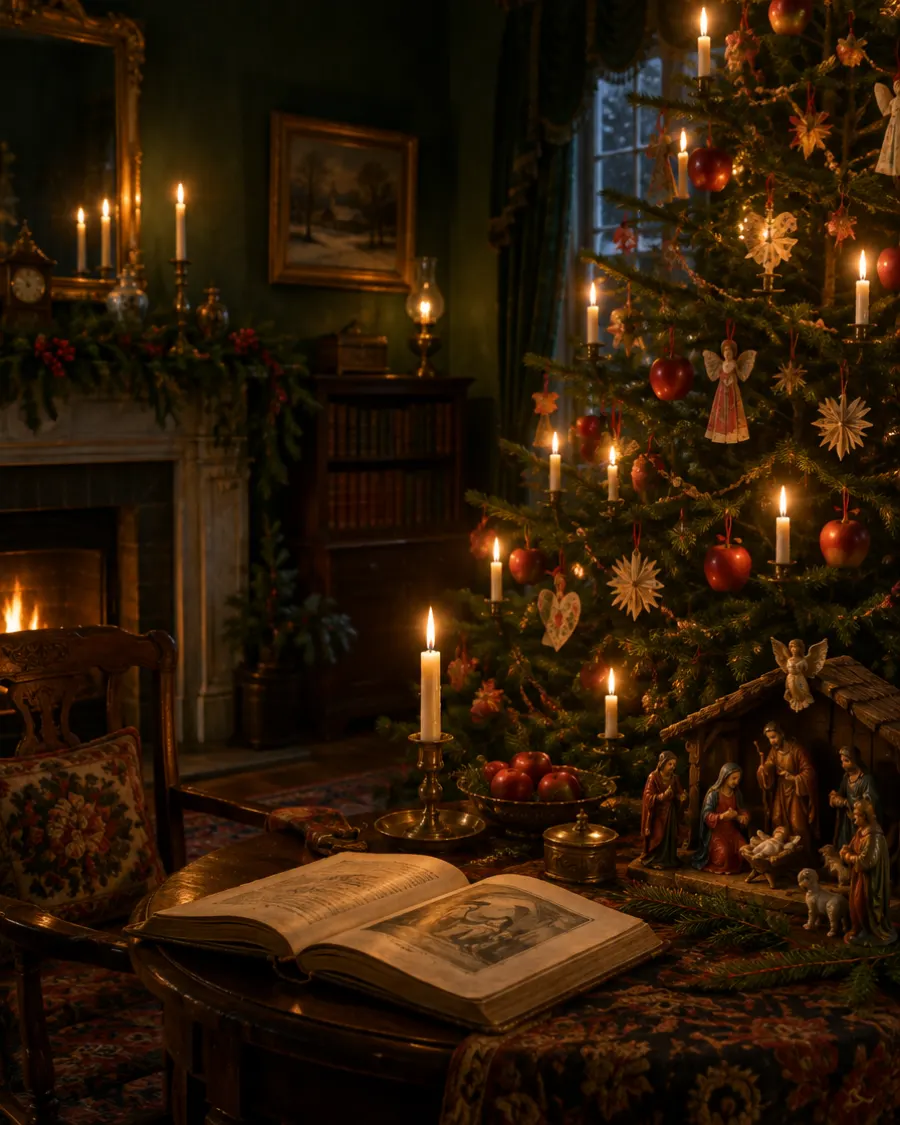
The decorated Christmas tree as we know it, though, grew up in the German-speaking lands and nearby regions of Central Europe. By the 1500s and 1600s, records from towns in the Rhine region and the Baltic describe evergreen trees set up at Christmas and hung with apples, nuts, wafers and paper flowers. One likely ancestor is the “paradise tree” — an evergreen hung with apples used in medieval plays about Adam and Eve, which were performed around December 24, their traditional feast day.
A popular story credits the reformer Martin Luther with adding candles to a tree after seeing stars shining through the branches of a forest. It is a charming tale, but there is no evidence from Luther’s own time to support it, so treat it as legend.
Over the 1700s and early 1800s, the tree spread from Protestant German households to German nobility and then to other European royal courts and middle-class homes.
Queen Victoria’s tree makes it fashionable
Britain’s royal family had German roots, and German-style trees appeared at court before Victoria’s reign. But the moment that made the Christmas tree a must-have came in 1848, when the Illustrated London News published an engraving of Queen Victoria, her German-born husband Prince Albert and their children gathered around a decorated tabletop tree at Windsor Castle.
The picture was widely copied. An American magazine reprinted a version of it in 1850 with the royal details changed — the queen’s crown and Albert’s sash removed — so that it looked like an ideal American family. Readers on both sides of the Atlantic wanted to copy the scene, and the tree became a symbol of a warm, family-centered Christmas.
How the tree spread across America
German immigrants brought the tree to America, especially to Pennsylvania, and it spread slowly in the early 1800s. At first some Americans viewed it as a foreign novelty. By the second half of the century, helped by magazines and that royal engraving, it had become popular in homes across the country.
- 1Tree lotsAs cities grew, farmers began cutting trees in the countryside and selling them on city streets.
- 2Electric lights, 1882Edward H. Johnson, an associate of Thomas Edison, showed off a tree strung with hand-wired electric bulbs in his New York home. Electric lights were expensive at first but slowly replaced dangerous candles.
- 3OrnamentsGlass ornaments from Germany were imported in large numbers in the late 1800s, and American manufacturers later made their own.
- 4Tree farmsIn the 20th century, growers began planting trees specifically for Christmas, which is where most real trees come from today.
Advertisement
America’s famous trees: the National Tree and Rockefeller Center
The National Christmas Tree. In 1923, President Calvin Coolidge lit the first National Christmas Tree on the Ellipse, just south of the White House, using electric lights. The tradition has continued in various forms since then, with a ceremony each year near the start of the season. The National Park Service manages the event; check its official site for current dates and free ticket information.
The Rockefeller Center tree. New York’s famous tree began humbly. In 1931, during the Great Depression, workers building Rockefeller Center pooled money for a small tree on the construction site and decorated it with homemade garlands. Two years later, in 1933, the center held its first official tree lighting, and it has been an annual tradition ever since. Today the tree is usually a large Norway spruce, and after the season the lumber has often been donated to build homes.
Many cities and towns now hold their own lighting ceremonies. Find ideas in our Christmas events guide.
Real vs. artificial tree: which should you choose?
Both kinds have loyal fans. Here is a fair comparison:
- Scent and feel. Real trees win easily — the fresh pine smell and the ritual of choosing a tree are big parts of the fun.
- Cost over time. A real tree is a yearly purchase. An artificial tree costs more upfront but can last many seasons if stored well.
- Effort. Real trees need daily watering and leave needles behind. Artificial trees need assembly and storage space.
- Allergies. Some people react to tree pollen, mold or sap on real trees. Others react to dust that collects on stored artificial trees; wiping them down helps.
- Environment. Real trees are a farmed crop that is replanted, and they can be recycled into mulch. Artificial trees are usually made of plastic and metal, often shipped from overseas, and are hard to recycle — but using one for many years spreads out its impact. Studies comparing the two generally find that an artificial tree has to be reused for a number of years to come out ahead.
- Fire safety. A well-watered real tree is hard to ignite; a dried-out one burns very fast. Artificial trees should be labeled fire-resistant.
Not sure how tall a tree your room can take, or how many lights and ornaments you need? Use our Christmas tree calculator.
Best Christmas tree types and how they differ
- 1Fraser firDark green, soft needles with silvery undersides, a pleasant scent and excellent needle retention. Its sturdy, upturned branches hold heavy ornaments well. Often one of the pricier choices.
- 2Douglas firSoft, fragrant needles that radiate around the branch and a full, cone-shaped look. Widely available, especially in the West. Branches are a bit softer, so choose lighter ornaments.
- 3Balsam firThe classic “Christmas smell.” Dark green, flat needles and a slender shape, popular in the Northeast and upper Midwest.
- 4Noble firBluish-green needles and stiff, well-spaced branches ideal for heavy ornaments. Long-lasting; its branches are also prized for wreaths and garland.
- 5Scotch pineStiff branches, longer needles and very good needle retention even if it dries a little. A budget-friendly, durable choice. Needles can be sharp.
- 6Concolor (white) firSoft, bluish needles with a light citrus scent. Good needle retention.
- 7Blue spruce and Norway spruceStriking shape and color, with sharp needles. Spruces tend to drop needles faster indoors unless they are kept well watered.
- 8Leyland cypressA popular choice in the South. Feathery foliage, almost no scent, and a good option for people bothered by strong pine smells.
How to pick a fresh tree
Whether you go to a lot, a garden center or a cut-your-own farm, a few simple checks help you bring home a tree that lasts:
- Measure first. Measure your ceiling height and leave room for the stand (several inches) and the topper. Measure the width of the space too — trees look much smaller outdoors.
- Do the needle test. Gently run a branch through your hand. Fresh needles bend and stay on. If many come off or feel brittle, keep looking.
- Bounce it. Lift the tree a few inches and tap the trunk on the ground. A few brown inner needles falling is normal; a shower of green needles is not.
- Check the color and smell. It should look green throughout and smell fresh.
- Check the trunk. Make sure the bottom 6–8 inches are straight enough to fit your stand.
- Cut-your-own farms give you the freshest tree and a fun family outing. Bring gloves, a tape measure and a saw if the farm doesn’t provide one.
Watering and care: how to keep a tree fresh
- 1Make a fresh cutUnless the tree was cut within the last few hours, saw a thin slice (about ½ inch) straight across the base before putting it in water. This opens the trunk so it can drink.
- 2Get it into water fastPut the tree in the stand soon after the cut. If the base dries, sap seals it and the tree stops drinking.
- 3Use a big enough standA common guideline is about 1 quart of water per inch of trunk diameter. Do not shave the bark to make a trunk fit a small stand.
- 4Check water every dayA fresh tree can drink a lot in the first few days. Never let the water drop below the base of the trunk.
- 5Plain water is enoughAdditives such as sugar, aspirin or bleach are not needed; clean water works best.
- 6Keep it coolPlace the tree away from heat vents, fireplaces, radiators and sunny windows, which dry it out.
With good care, many real trees stay fresh for about four to five weeks. When needles turn brittle and fall when touched, it is time to take the tree down.
Christmas tree fire safety
Christmas tree fires are not common, but when they happen they can spread shockingly fast, because a dry tree burns almost like kindling. Fire safety organizations recommend:
- Keep the tree at least 3 feet from any heat source — fireplaces, space heaters, candles, radiators and heat vents.
- Never put lit candles on or near a tree.
- Use lights that are listed by a recognized testing laboratory (look for a mark such as UL, ETL or CSA), and choose indoor or outdoor lights as labeled.
- Replace any light strings with frayed wires, cracked sockets or loose connections.
- Follow the maker’s directions on how many light strands can be connected end to end.
- Turn off tree lights before leaving home or going to bed.
- Make sure the tree doesn’t block an exit, and keep working smoke alarms on every level of your home.
- Take a real tree down once it dries out, and never leave it leaning against the house or garage afterward.
Never burn Christmas tree branches or wrapping paper in a fireplace or wood stove. They can flare up suddenly and send sparks into the chimney.
For more on lights, see our decorating and light safety guide.
Recycling your tree after Christmas
Real trees are biodegradable, and most communities offer ways to give them a second life:
- Curbside pickup. Many cities collect trees for a few weeks after the holidays and turn them into mulch or compost. Check your city’s website for dates and rules.
- Drop-off sites. Parks departments and recycling centers often run drop-off points.
- Remove everything. Take off every ornament, hook, light, piece of tinsel and the stand. Most programs won’t accept flocked trees or trees in plastic bags.
- Backyard uses. Branches can shelter birds in winter or cover perennial beds, and the trunk can be cut for garden edging.
Artificial trees are rarely accepted by recycling programs. If yours is still in good shape, donate it or offer it to a neighbor rather than throwing it away.
Frequently asked questions
When did Christmas trees come to America?
German immigrants brought the custom in the late 1700s and early 1800s, especially to Pennsylvania. It became widely popular in the second half of the 1800s.
What is the best type of real Christmas tree?
Fraser fir is a favorite for needle retention and sturdy branches. Douglas and Balsam firs are prized for scent, Noble fir for heavy ornaments, and Scotch pine for durability on a budget.
How long does a real Christmas tree last?
With a fresh cut and daily watering, many real trees stay fresh for about four to five weeks indoors.
When did the Rockefeller Center tree tradition start?
Construction workers put up a small tree in 1931, and the first official tree lighting at Rockefeller Center was held in 1933.
Advertisement