Updated Oct 26, 2026
One holiday, many traditions
Christmas is celebrated in more than a hundred countries, and almost every one has made it its own. Dates differ, foods differ, and even the person who brings gifts changes from place to place. Many American traditions came from immigrants who carried these customs across the ocean — which is why learning how other countries celebrate often explains our own holiday.
One big difference is the calendar. Most Western churches celebrate on December 25. Several Orthodox churches still follow the older Julian calendar for church feasts, so their Christmas falls on January 7 on the calendar most of the world uses. Other cultures place the main gift-giving on December 6, Christmas Eve or January 6.
Here is a respectful tour of how families in a dozen places mark the season.
Mexico: Las Posadas
In Mexico and in many Mexican American communities, the nine nights from December 16 to 24 are the season of Las Posadas (“the inns”). Each night, neighbors reenact Mary and Joseph’s search for shelter in Bethlehem. A procession, sometimes led by children dressed as the holy family, walks from house to house carrying candles and singing a traditional song that asks for lodging. At planned stops the “innkeepers” sing back that there is no room — until the last house opens its doors and everyone is welcomed inside.
The night ends with a party: tamales, warm ponche (a fruit punch with cinnamon and sugarcane), and a star-shaped piñata. The traditional seven-pointed piñata is often explained as representing the seven deadly sins, broken by faith.
On Nochebuena (Christmas Eve), families gather for a late dinner and Mass. Many children receive gifts on January 6, Día de los Reyes (Three Kings Day), when families share a ring-shaped sweet bread called rosca de reyes with a small figure of the baby Jesus baked inside.
Germany: Advent and the Christmas markets
Germany gave the world many beloved customs, including the decorated Christmas tree, the Advent wreath and the Advent calendar. The season starts four Sundays before Christmas, when families light the first candle on their wreath.
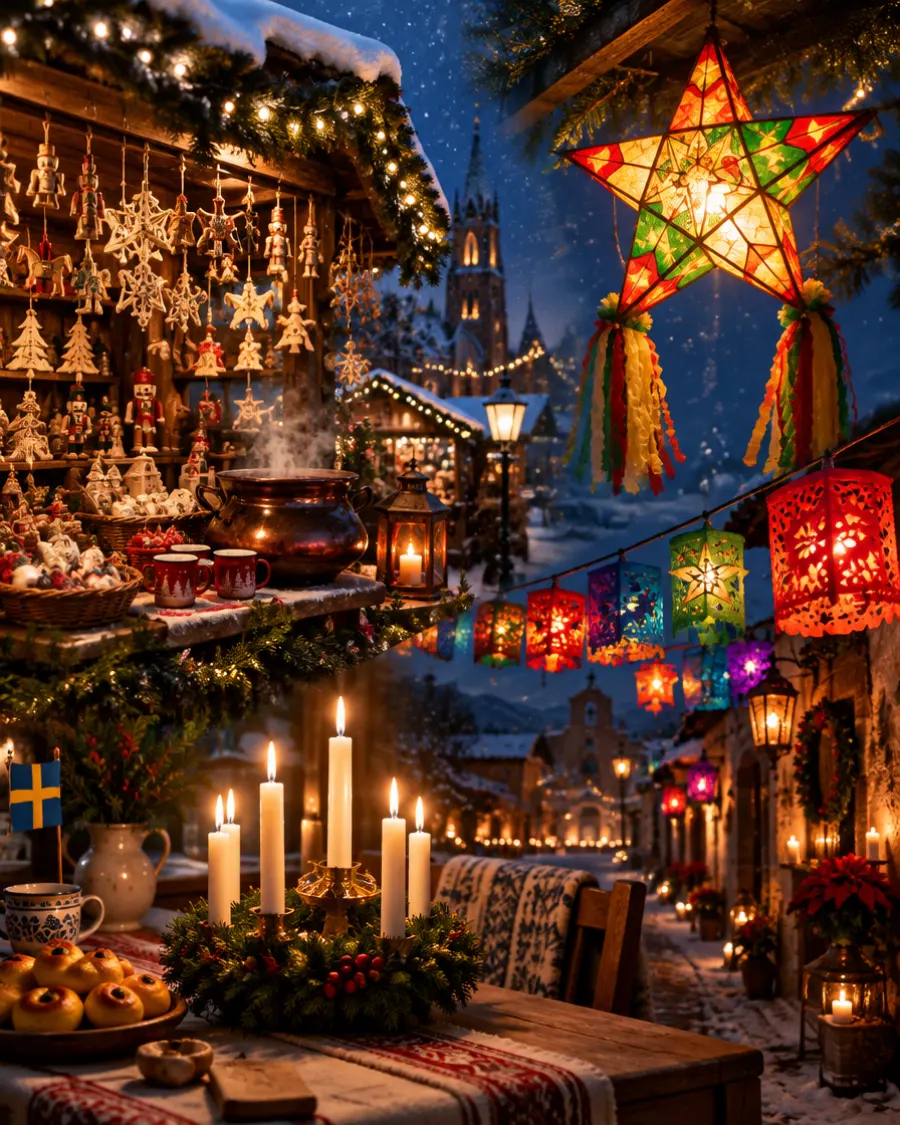
Many towns hold a Weihnachtsmarkt (Christmas market), a tradition that goes back to the late Middle Ages. Wooden stalls fill the town square selling handmade ornaments, wooden toys, roasted almonds, sausages, gingerbread (Lebkuchen) and hot spiced wine (Glühwein). Markets in cities such as Nuremberg and Dresden are famous, and Dresden is known for its fruit bread, Stollen.
On December 6, children put their boots out for St. Nikolaus. The main celebration is on Christmas Eve (Heiligabend), when gifts are opened — brought by the Christkind in some regions and the Weihnachtsmann in others. December 25 and 26 are both public holidays.
Many American cities now host German-style Christmas markets. See our events guide.
Advertisement
Italy: the presepe and La Befana
In Italy, the presepe (Nativity scene) is the heart of home decorating. Naples is famous for elaborate handmade figures, and some families add new pieces every year. The baby Jesus is traditionally placed in the manger on Christmas Eve.
Many families eat a meatless Christmas Eve meal, and Italian Americans turned this into the Feast of the Seven Fishes. Christmas Day brings a large lunch, and sweet breads such as panettone and pandoro are everywhere.
The season ends with La Befana. On the night of January 5, before Epiphany, a kindly old woman on a broomstick is said to fill children’s stockings with candy — or with “coal” (usually black sugar candy) for those who misbehaved. In the legend, she was too busy sweeping to join the wise men on their journey, and she still searches for the Christ Child, leaving gifts at every house along the way.
Sweden: St. Lucia Day (December 13)
In Sweden and across Scandinavia, St. Lucia Day on December 13 brings light to the darkest weeks of the year. Lucia was an early Christian martyr from Sicily, and in the old calendar her day fell near the winter solstice.
In schools, churches and towns, a girl chosen as Lucia wears a white gown with a red sash and a crown of candles (usually battery-powered today). She leads a procession of girls and boys in white, singing traditional songs. At home, children may bring their parents coffee and saffron buns called lussekatter in the early morning.
Swedes celebrate Christmas mainly on Christmas Eve (julafton) with a buffet called the julbord — ham, herring, meatballs, sausages and rice pudding. A Swedish family tradition is watching a classic Disney cartoon special on television in the afternoon.
The Philippines: Simbang Gabi and the parol
The Philippines, where most people are Catholic, is known for one of the longest Christmas seasons in the world — decorations and carols can start as early as September.
The highlight is Simbang Gabi, a series of nine dawn (or evening) Masses held from December 16 to 24. Families attend together, then buy hot snacks from stalls outside the church: bibingka (rice cake baked in banana leaves) and puto bumbong (purple sticky rice). Many people believe that completing all nine Masses lets you make a special wish.
The symbol of the season is the parol, a star-shaped lantern representing the star of Bethlehem. Traditional parols were made of bamboo and paper; today they range from simple homemade stars to huge, dazzling light displays. On Christmas Eve, families share the Noche Buena feast after midnight Mass. Filipino American parishes in the U.S. hold Simbang Gabi too.
The Netherlands: Sinterklaas (December 5)
For Dutch children, the big gift night comes before Christmas. Sinterklaas — St. Nicholas in a bishop’s robe and miter — arrives in the Netherlands by steamboat in mid-November, welcomed by crowds and television coverage. Over the following weeks, children leave shoes by the fireplace, sometimes with a carrot for his horse, and find small treats in the morning.
On December 5, the eve of St. Nicholas Day, families exchange gifts, often with a playful twist: presents come with humorous poems and are hidden inside creative disguises called surprises. Chocolate letters and spiced cookies are traditional treats.
Christmas itself, on December 25 and 26, is a quieter family holiday centered on meals. Dutch Sinterklaas is one of the roots of the American Santa Claus.
Japan and Australia: Christmas in Asia and the Pacific
Japan: a romantic, festive Christmas
Only a small share of people in Japan are Christian, so Christmas is not a public holiday and is not a religious occasion for most families. It is still a popular festive season, with city illuminations, decorated shops and holiday music.
Two customs stand out:
- Christmas Eve as a date night. Couples often go out for a special dinner or to see the lights, a bit like Valentine’s Day in the U.S.
- Fried chicken and Christmas cake. A fast-food chain’s advertising campaign in the 1970s helped make fried chicken a popular Christmas meal, and many families order it ahead. Dessert is the kurisumasu keki — a light sponge cake with whipped cream and strawberries.
The more important family holiday in Japan is the New Year, when people visit shrines and share special foods.
Australia: Christmas in summer
In the Southern Hemisphere, December falls in summer. Australians keep many familiar traditions — trees, Santa, carols, stockings — but adapt them to the heat.
- Carols by Candlelight concerts are held outdoors in parks, with families bringing picnics and candles.
- Christmas lunch often includes seafood such as prawns and oysters, cold meats and salads, though some families still serve a traditional roast.
- Dessert might be pavlova, a meringue topped with cream and fresh fruit.
- Many people head to the beach or a backyard barbecue in the afternoon.
December 26, Boxing Day, is also a holiday, known for sports and shopping. New Zealand celebrates in a similar summery style.
Ethiopia, Iceland and Ukraine: three distinctive Christmases
Ethiopia: Genna (January 7)
The Ethiopian Orthodox Tewahedo Church, one of the oldest Christian churches in the world, celebrates Christmas, called Genna (also spelled Ganna), on January 7 on the Western calendar.
Many believers fast in the weeks beforehand. On Christmas Eve, people dress in traditional white clothing, often a thin cotton shawl called a netela, and attend services that can last through the night, sometimes holding candles as they walk around the church. Afterward families break the fast with a festive meal — a spicy chicken stew called doro wat served with injera, a spongy flatbread.
The holiday is traditionally associated with a field game also called genna, similar to field hockey, which young men play on the day. Gift-giving is a small part of the celebration compared with worship, food and family.
Iceland: the 13 Yule Lads
Iceland has some of the most unusual Christmas folklore in the world. Instead of one Santa, there are 13 Yule Lads (jólasveinar), mischievous brothers who come down from the mountains, one each night, in the 13 nights before Christmas. Each has a name that describes his prank — one licks spoons, one slams doors, one steals sausages, one peeks through windows.
Children leave a shoe on the windowsill, and each Yule Lad leaves a small gift for good children — or a potato for naughty ones. The lads’ mother is Grýla, a fearsome troll from older folk tales, and their pet is the Yule Cat, said to threaten anyone who doesn’t receive new clothes for Christmas. Parents today tell these stories playfully.
Another lovely Icelandic custom is the Jólabókaflóð (“Christmas book flood”): books are popular gifts, and many families spend Christmas Eve reading.
Ukraine: Sviat Vechir and a new date
For generations, most Ukrainians celebrated Christmas on January 7, following the Julian calendar. In 2023, after the Orthodox Church of Ukraine and the Ukrainian Greek Catholic Church adopted a revised calendar, Ukraine moved its official public Christmas holiday to December 25. Some families and parishes still keep January 7.
The most important moment is Sviat Vechir (“Holy Evening”), Christmas Eve. Families traditionally wait for the first star to appear before sitting down to a meatless supper of 12 dishes, often said to honor the 12 apostles. The first dish is usually kutia, made of wheat berries, poppy seeds, honey and nuts. A sheaf of wheat called a didukh may be placed in the home as a symbol of ancestors and harvest.
Ukraine is also famous for carols. The tune Americans know as “Carol of the Bells” comes from a Ukrainian folk chant arranged by composer Mykola Leontovych, called “Shchedryk.” Learn more in our carols guide.
More traditions worth knowing
- 1United KingdomChristmas crackers with paper crowns at dinner, mince pies, Christmas pudding and a royal Christmas message on TV.
- 2FranceA late Christmas Eve feast called le Réveillon and the log-shaped cake bûche de Noël.
- 3PolandWigilia supper on Christmas Eve, sharing a thin wafer called opłatek and leaving an empty seat for an unexpected guest.
- 4SpainGifts from the Three Kings on January 6 and a huge national lottery drawing before Christmas.
- 5VenezuelaIn Caracas, some people roller-skate to early-morning Christmas Masses.
- 6NorwayAn old custom of hiding brooms on Christmas Eve, from folk beliefs about witches out that night.
Bringing a world tradition into your own home is a great way to teach kids about other cultures — try baking a Swedish saffron bun, hanging a Filipino parol or building a Mexican-style piñata. Pair it with our family activities guide.
Frequently asked questions
Which countries celebrate Christmas on January 7?
Churches that follow the Julian calendar, including the Ethiopian, Russian, Serbian and some other Orthodox churches, celebrate Christmas on January 7. Ukraine moved its official holiday to December 25 in 2023.
What is Las Posadas?
A Mexican tradition held December 16–24 in which neighbors reenact Mary and Joseph’s search for shelter, ending each night with food, drinks and a piñata.
Who brings gifts in Italy?
La Befana, a kind old woman on a broomstick, fills children’s stockings on the night of January 5, before Epiphany. Many Italian families also exchange gifts at Christmas.
What are the Yule Lads?
Thirteen mischievous brothers from Icelandic folklore who visit one at a time in the 13 nights before Christmas, leaving small gifts in children’s shoes.
Advertisement