Updated Oct 26, 2026
What is NORAD Tracks Santa?
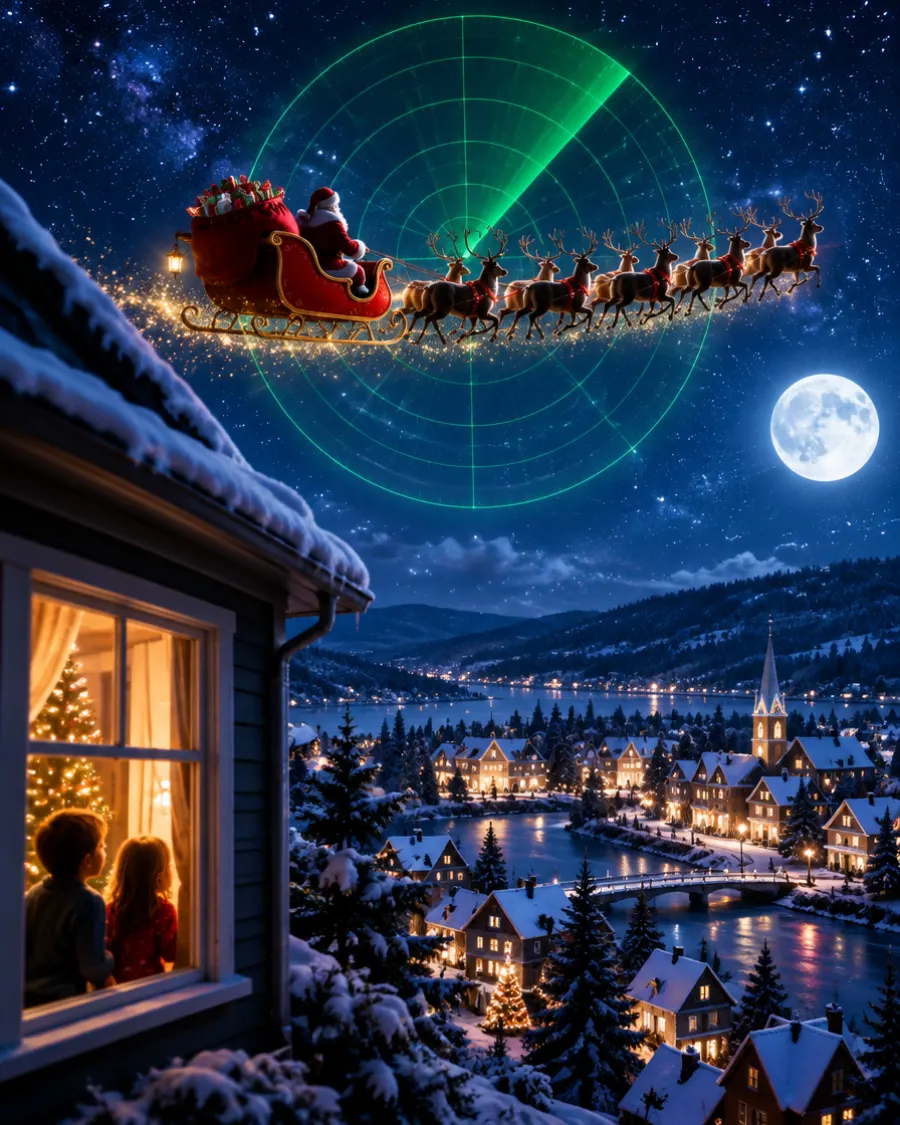
Every Christmas Eve, the North American Aerospace Defense Command — NORAD, the joint U.S.–Canadian military command that watches the skies over North America — turns part of its attention to a very special flight: Santa Claus and his reindeer-powered sleigh. Through a website, phone lines and social media, NORAD shares updates on Santa’s “location” as he travels around the world delivering presents.
It is a lighthearted program run largely by volunteers, and it has become one of the best-loved Christmas Eve traditions for families in the United States, Canada and beyond. Its origin story — a phone number printed by mistake — is almost too charming to be true, but the basic facts are well documented.
The official home of the program is noradsanta.org.
The 1955 wrong number
In December 1955, a Sears store ran a newspaper advertisement in the Colorado Springs area inviting children to call Santa Claus on a special phone line. But the number in the ad was misprinted. Instead of reaching the store’s Santa, children who dialed it reached a phone at the Continental Air Defense Command (CONAD) operations center in Colorado Springs — a line meant for serious military business.
The officer on duty was Colonel Harry Shoup of the U.S. Air Force. When the first child asked for Santa, he could have hung up. Instead, according to the story his family and the military have told ever since, he played along. Shoup reportedly had his staff check the radar for any sign of Santa and give the children who called a “current location” for the sleigh.
Accounts differ on some details — exactly which phone the number reached, and how many calls came in — but the core of the story is consistent: a misprint, a surprised colonel, and a decision to make children happy instead of correcting them. Shoup came to be fondly known as the “Santa Colonel.”
The story is a real piece of Cold War history: a command built to watch for enemy bombers ended up starting one of the sweetest holiday traditions in America.
From CONAD to NORAD
The tradition continued after that first year. In 1958, the United States and Canada formed NORAD as a joint command to defend North American airspace, and it took over the job of tracking Santa from CONAD. Over the following decades, the program grew from a few phone calls into a worldwide event.
Early on, the updates reached the public mostly through radio and newspaper reports. Later came television, and in the internet era the program launched its own website. Today it uses a website with an interactive map, a phone hotline, social media channels and mobile apps, and it offers information in several languages.
Advertisement
How NORAD Tracks Santa works today
The details shift slightly from year to year, so always check noradsanta.org in December for this season’s plans. In general, here is how the program works:
- 1December: the countdownThe website typically opens weeks before Christmas with games, music, videos and facts about Santa’s village and the program.
- 2December 24: tracking dayOn Christmas Eve, the site’s map begins showing Santa’s route as he starts his journey and travels west across time zones through the day and night.
- 3Phone lines openOn Christmas Eve, volunteers answer calls from children asking where Santa is. NORAD has long used the number 1-877-HI-NORAD; confirm the current number on the official site.
- 4Volunteers on dutyMilitary members, civilian staff and their families volunteer in shifts at an operations center in Colorado, many of them returning year after year.
- 5Apps and social mediaOfficial channels post updates through the day. Some smart speakers and mapping services have also offered Santa-tracking features.
In the playful spirit of the program, NORAD says it watches Santa with the same tools it uses every day — radar, satellites and fighter jets — plus special “Santa Cams.” Kids love asking how fast the sleigh is going, and the website’s fun facts are ready with answers.
Only use the official website and phone number listed at noradsanta.org. Be cautious of look-alike apps or sites that ask for personal information or payments.
How to follow Santa with your kids
NORAD Tracks Santa works best as a gentle, all-day thread running through Christmas Eve rather than a screen to stare at. Some ideas:
- Morning check-in. Look at the map together after breakfast to see where Santa is starting — usually somewhere far across the Pacific.
- Geography game. Each time you check, find the country or city on a paper map or globe and talk about the time of day there. Kids learn about time zones without realizing it.
- Make a call. If you can get through on the phone line, let your child ask a volunteer where Santa is. Have a backup plan — lines can be busy.
- Track and bake. Bake cookies for Santa while he crosses Asia and Europe — find recipes in our Christmas cookie guide.
- Write a last-minute note. Use our Santa letter maker for a note to leave beside the cookies.
- Final check before bed. Peek at the map one last time, then explain that Santa will not come until everyone is asleep.
When does Santa come? The bedtime tradition
One of the questions children ask most on Christmas Eve is, “What time will Santa get to our house?” The tradition in many American families has a simple answer: Santa only comes after the children are asleep.
This idea runs deep in Christmas folklore. Clement Clarke Moore’s famous 1823 poem, “’Twas the Night Before Christmas,” describes the children “nestled all snug in their beds” while St. Nicholas arrives. Many parents add their own touch: if Santa’s map shows him getting close to your region, it is time to hurry to bed, because he will skip a house where children are still awake and come back later.
The NORAD map is a helpful bedtime tool. When it shows Santa approaching your part of the world, it is a natural signal to brush teeth, set out milk and cookies, and turn off the lights. Read more about bedtime customs in our Christmas Eve traditions guide.
A tip from many families: decide your house’s “Santa rule” in advance and keep it consistent from year to year — kids find comfort in knowing what to expect.
A sample Christmas Eve tracking plan
Santa’s route usually begins on the far side of the world, where Christmas Eve night arrives first, and moves west with the darkness. For families in the continental United States, that means the journey is already well underway during the day on December 24, and Santa reaches North America in the evening. Here is a relaxed plan many families follow — adjust it to your own bedtime and time zone:
- 1MorningOpen the NORAD site, watch the countdown or the first updates, and mark Santa’s starting area on a paper map or globe.
- 2LunchtimeCheck again. Talk about which countries are already celebrating and what time it is there now.
- 3AfternoonBake cookies, wrap a last gift or make reindeer food while Santa crosses continents. Try calling the hotline if your child wants to.
- 4DinnerMake a game of guessing where Santa will be by dessert. Write the guesses down and check after the meal.
- 5BedtimeSet out the snack for Santa, read “’Twas the Night Before Christmas,” take one final look at the map and turn out the lights.
If you live in Hawaii or Alaska, or are traveling abroad, Santa’s “arrival” in your region will come at a different hour — the map handles time zones for you. For a cozy themed evening, combine tracking with ideas from our family activities guide.
Tip for screen-free families: one grown-up can check the map privately and announce “Santa updates” at dinner, like a news bulletin. Kids often love the drama even more than the screen.
Answering kids’ tricky questions
Following Santa’s route often inspires big questions. Here are gentle ways families answer them:
- “How does Santa visit every house in one night?” Many parents say Christmas magic stretches time, or that Santa takes advantage of time zones — he travels with the night as it moves around the world.
- “What if we don’t have a chimney?” Santa has a magic key, comes through the front door or uses any way he likes. Some families hang a decorative “Santa key” on the doorknob.
- “Is NORAD real?” Yes — NORAD is a real military command that protects the skies over the United States and Canada. Santa tracking is the fun, volunteer side of its work.
- “Does Santa visit kids everywhere?” Christmas customs differ around the world; in some countries other gift-bringers visit, or gifts come on a different day. See our Christmas around the world guide.
Why this tradition endures
Part of NORAD Tracks Santa’s charm is that it treats children’s imagination with respect. Serious adults in uniform, at a real operations center, take the time to tell a child that Santa is just over the Atlantic. Families who grew up calling the hotline now share it with their own children.
It also connects to the oldest Santa traditions in America — from Moore’s poem to letters mailed to the North Pole. Learn more about how the jolly gift-giver developed in our Santa Claus history, and count down the days until the tracking starts with our Christmas countdown.
Frequently asked questions
How did NORAD start tracking Santa?
In December 1955, a Sears newspaper ad in the Colorado Springs area misprinted a phone number for children to call Santa. Calls reached the Continental Air Defense Command, where Col. Harry Shoup played along and had staff give callers Santa’s “location.” NORAD, formed in 1958, continued the tradition.
What is the official NORAD Santa tracker website?
The official site is noradsanta.org. It usually opens in December with games and information and shows Santa’s journey live on December 24.
What is the NORAD Santa phone number?
NORAD has long used 1-877-HI-NORAD for its Christmas Eve hotline. Confirm the current number and hours on noradsanta.org before calling, as details can change.
What time does Santa come to my house?
Family tradition says Santa only arrives after the children are asleep. When the NORAD map shows him getting close to your region, it is a good signal to head to bed.
Advertisement