Updated Oct 26, 2026
Evergreens, holly and wreaths
Long before Christmas trees, people decorated with evergreen boughs in winter. Plants that stayed green when everything else looked dead became natural symbols of life continuing through the cold. Christians later gave them new meanings, and the custom of “decking the halls” survived into the modern holiday.
Holly was used in winter decorations in ancient Rome and northern Europe. In Christian symbolism, its sharp leaves came to stand for the crown of thorns and its red berries for Christ’s blood. The carol “The Holly and the Ivy” reflects these meanings. Note that holly berries are toxic if eaten — keep them away from children and pets.
Wreaths are circles of evergreen with no beginning and no end, often read as a symbol of eternity or everlasting life. Hanging a wreath on the front door is one of the most common American decorations, and fresh wreaths of fir, pine, cedar or boxwood smell wonderful. The Advent wreath, a table wreath with candles, is a separate tradition explained below.
Mistletoe: why we kiss under it
Mistletoe is a plant that grows on the branches of trees, staying green in winter even when its host tree is bare. That odd habit made it seem magical to many ancient peoples.
- The Roman writer Pliny the Elder described Celtic Druids ceremonially cutting mistletoe from oak trees and treating it as sacred.
- In a Norse myth, the god Baldur is killed by a spear or arrow made of mistletoe. Later retellings add a happier ending linking mistletoe to love, though those additions are not found in the oldest sources.
The custom of kissing under the mistletoe is much younger. It is recorded in England by the 18th century, when servants and then households hung “kissing boughs” at Christmas. One old rule said a berry should be picked for each kiss, and when the berries ran out, so did the kisses.
Mistletoe berries and leaves can make people and pets sick. Hang it high, or use artificial mistletoe if you have small children or curious animals.
Poinsettias: Mexico’s Christmas flower
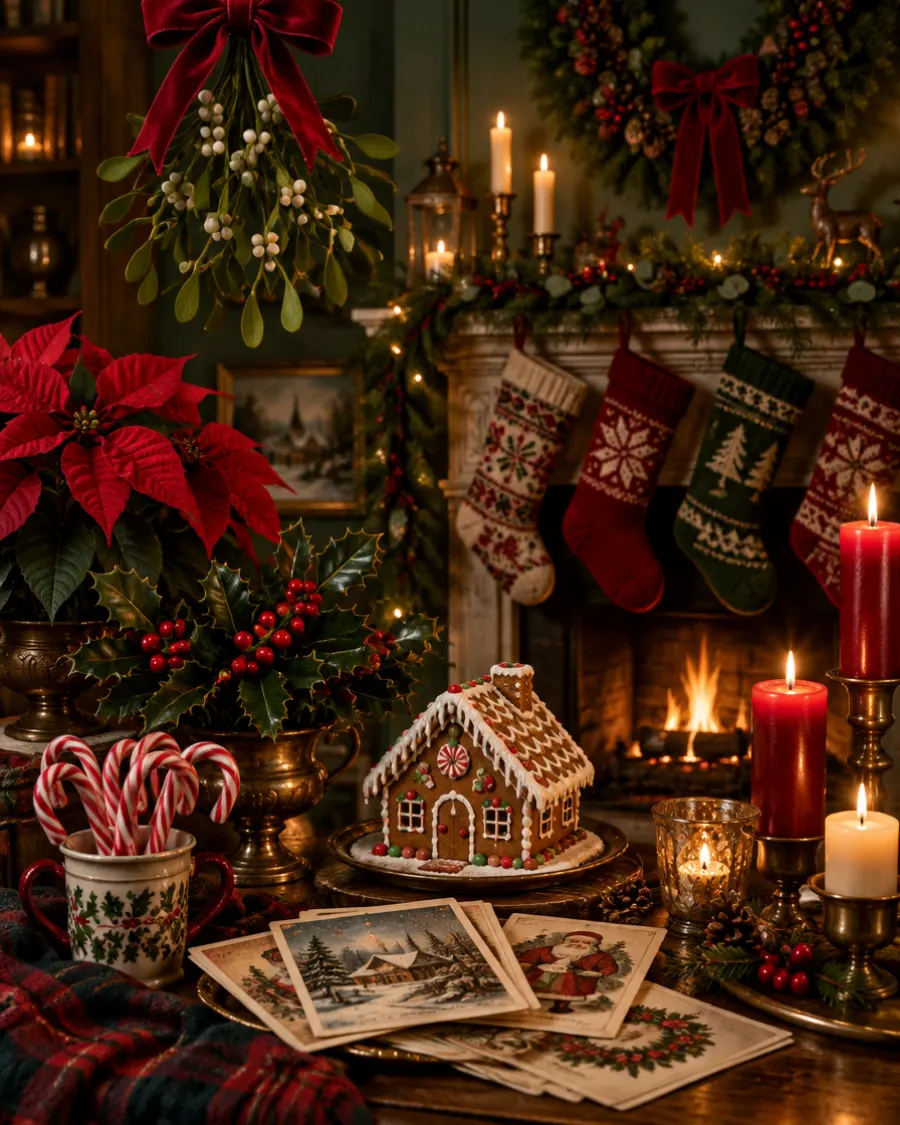
The poinsettia is native to Mexico, where it is called flor de Nochebuena — the “Christmas Eve flower.” Its bright red “petals” are actually colored leaves called bracts; the true flowers are the tiny yellow buds in the center. In Mexico, a well-known legend tells of a poor girl with no gift for the Christ Child who brings weeds to church, which bloom into red stars.
The plant’s English name comes from Joel Roberts Poinsett, the first U.S. minister to Mexico in the 1820s. An amateur botanist, he sent cuttings home to South Carolina, and the plant spread to American greenhouses. December 12, the anniversary of Poinsett’s death, is observed as National Poinsettia Day.
Poinsettias are often said to be deadly to pets. That reputation is exaggerated: the milky sap can irritate the mouth and stomach and may cause mild upset, but serious poisoning is rare. It is still wise to keep them out of reach.
Care tip: Keep poinsettias in bright, indirect light, away from drafts and heaters, and water when the soil surface feels dry.
Advertisement
Christmas stockings
The custom of hanging stockings is often linked to a legend about St. Nicholas. He secretly tossed gold into the home of a poor father who could not afford dowries for his daughters, and in some versions the gold landed in stockings hung by the fire to dry. Historians can’t trace a direct line from the legend to the custom, but it is the story most families tell.
In the 1823 poem “A Visit from St. Nicholas,” the stockings are “hung by the chimney with care,” and that image helped make stockings a fixed part of the American Christmas. Traditional stocking stuffers include an orange or clementine in the toe (sometimes said to stand for St. Nicholas’ gold), nuts, candy and small toys. Some families still say naughty children get a lump of coal.
Need ideas? Browse our gift ideas tool for small stocking stuffers by age and budget.
Candy canes and gingerbread houses
Candy canes: legend and history
You may have heard that the candy cane was invented by a choirmaster in Cologne, Germany, in the 1600s, who bent sugar sticks into shepherds’ crooks to keep children quiet during long services. It is a lovely story, but there is no record from that time to prove it — it is best treated as legend. Another popular tale says the shape is a “J” for Jesus and the stripes have special religious meanings; these explanations appeared much later and are not supported by historical evidence.
What is clearer: hard sugar sticks were common sweets in Europe and America by the 1800s, some were hung on Christmas trees, and the familiar red-and-white striped candy cane appears in pictures from around the start of the 20th century. Machines that could bend the canes automatically, introduced in the mid-20th century, made them cheap and widely available.
Fun ways to use them: crush them over hot cocoa or brownies, hang them on the tree, or use them as handles on homemade gingerbread house fences.
Gingerbread and gingerbread houses
Spiced honey cakes and gingerbread have been baked in Europe for centuries, and Germany became especially famous for its Lebkuchen. Gingerbread was sold at fairs and markets, sometimes shaped into hearts, figures or animals.
Decorated gingerbread houses became popular in Germany in the 1800s, around the time the Brothers Grimm published the fairy tale of Hansel and Gretel, with its witch’s house made of bread, cake and sugar. Historians are not sure whether the tale inspired the houses or the houses inspired the way people pictured the tale, but the two have been linked ever since.
Today, building a gingerbread house is a favorite family project. Bake your own panels or start with a kit. For recipes, see our Christmas cookie guide.
Christmas cards
The first commercial Christmas card was created in England in 1843 by Sir Henry Cole, a busy civil servant who had too many friends to write to by hand. He asked artist John Callcott Horsley to design a card showing a family raising a toast, with scenes of charity on either side and the greeting “A Merry Christmas and a Happy New Year to You.” Copies were printed and sold.
Cheaper printing and the spread of affordable postage made cards popular in Britain, and by the late 1800s American printers were producing them in large numbers. Today families send printed cards, photo cards and digital greetings. A handwritten note inside still means the most.
Advent calendars and Advent wreaths
Advent is the season of preparation before Christmas in many Christian churches. It begins on the fourth Sunday before Christmas.
- The Advent wreath is a circle of evergreens holding four candles, one lit on each Sunday of Advent, often with a fifth candle in the center for Christmas. A widely told origin credits Johann Hinrich Wichern, a Lutheran pastor in Hamburg, who in the 1830s made a large wheel of candles to help children at his mission count down to Christmas.
- The Advent calendar also comes from Germany. Families once counted down with chalk marks or by lighting candles; printed calendars with little doors appeared in the early 20th century, and chocolate-filled versions came later. Today you can find calendars filled with toys, tea, socks or puzzles.
Learn more in our Advent guide, or keep track with the Christmas countdown.
Stars, angels, bells and lights
- 1The starRecalls the star that, in Matthew’s gospel, guided the wise men to Bethlehem. A star is a classic tree topper.
- 2The angelRecalls the angels who announced Jesus’ birth to the shepherds in Luke’s gospel — the other favorite tree topper.
- 3BellsChurch bells ring out on Christmas Eve and Christmas morning in many places, and sleigh bells add a wintry jingle. Bells appear in carols from “Jingle Bells” to “Carol of the Bells.”
- 4Candles and lightsLight in the darkest time of year is one of the oldest winter symbols. Christians connect it to Jesus as “the light of the world.” Electric lights replaced candles in the 20th century.
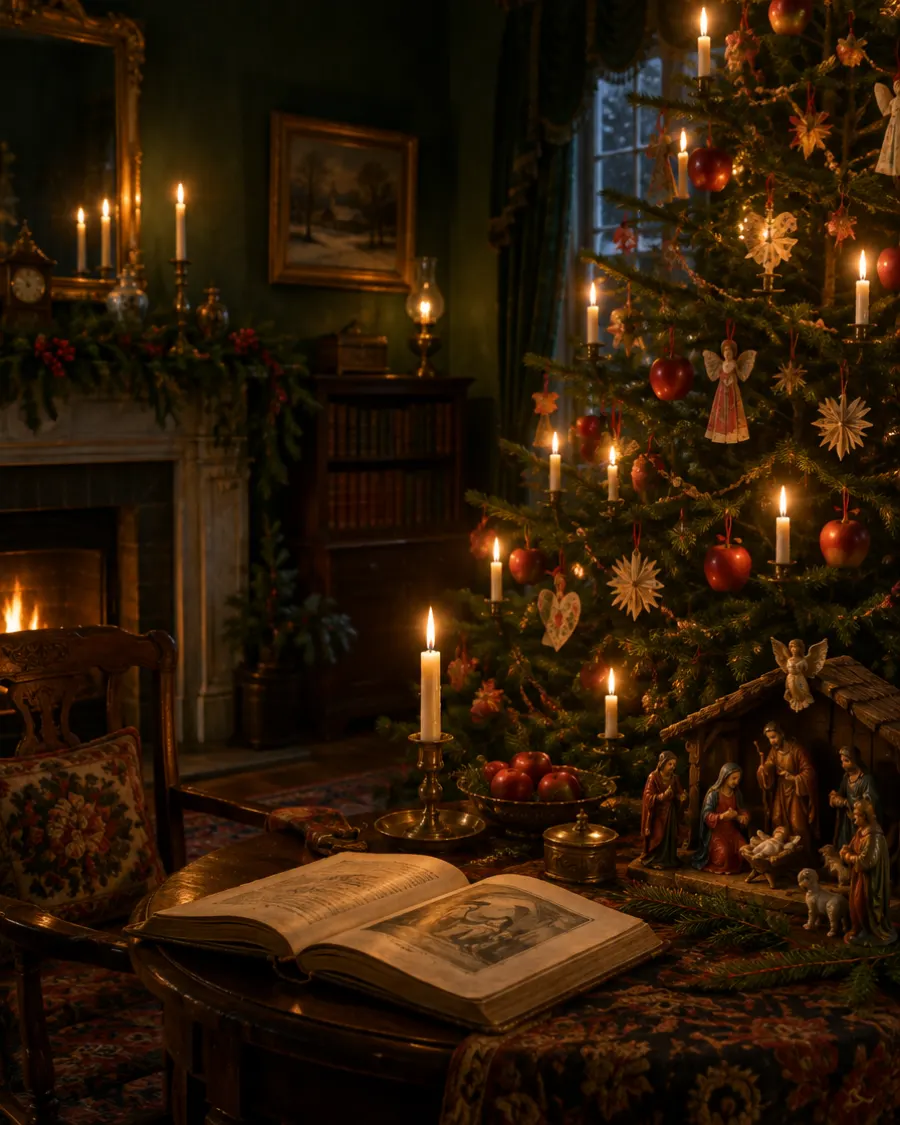
- 5The Nativity sceneA model of the stable with Mary, Joseph, the baby Jesus, shepherds and animals, often linked to Francis of Assisi in the 13th century.
- 6Red and greenThe classic colors come from holly and evergreens. Gold and white are also traditional, especially in churches.
Find the best light displays near you with our Christmas lights guide.
Rudolph, elves and newer traditions
Some “traditional” symbols are surprisingly recent. Rudolph the Red-Nosed Reindeer was created in 1939 by Robert L. May for a department store booklet. Other newer favorites include:
- The elf on the shelf — a scout elf toy who “watches” children and moves around the house each night, popular since the 2000s.
- Ugly Christmas sweaters — once an accidental fashion, now the theme of parties and contests.
- Christmas pajamas — matching family pajamas, often opened on Christmas Eve.
- The pickle ornament — hiding a glass pickle on the tree for children to find. It is often called a German tradition, but most Germans have never heard of it, and its origin is unclear.
- Secret Santa exchanges — organize one in minutes with our Secret Santa generator.
Christmas Eve traditions
For many families, Christmas Eve is the most magical night of the season. Common American traditions include:
- Attending a candlelight or midnight church service.
- Opening one gift early, often new pajamas.
- Reading “’Twas the Night Before Christmas” aloud.
- Leaving cookies and milk for Santa and carrots for the reindeer.
- Tracking Santa’s flight online — see our NORAD tracker guide.
- A special meal: in Italian American homes, the Feast of the Seven Fishes; in Mexican American homes, tamales; in Polish American homes, the Wigilia supper.
- Driving around to look at Christmas lights.
Find more ideas in our full Christmas Eve guide.
Frequently asked questions
Why do we kiss under the mistletoe?
Mistletoe was considered special by ancient peoples, but the kissing custom itself is recorded in England by the 18th century, when households hung “kissing boughs” at Christmas.
What is the real story of the candy cane?
The tale of a 1600s German choirmaster inventing candy canes is a legend with no supporting records. Striped candy canes appear around 1900, and machines made them widespread in the mid-1900s.
Why are poinsettias a Christmas flower?
They are native to Mexico, where they are called the Christmas Eve flower. Joel Roberts Poinsett, the first U.S. minister to Mexico, introduced them to the U.S. in the 1820s.
Who sent the first Christmas card?
Sir Henry Cole commissioned the first commercial Christmas card in England in 1843.
Advertisement